




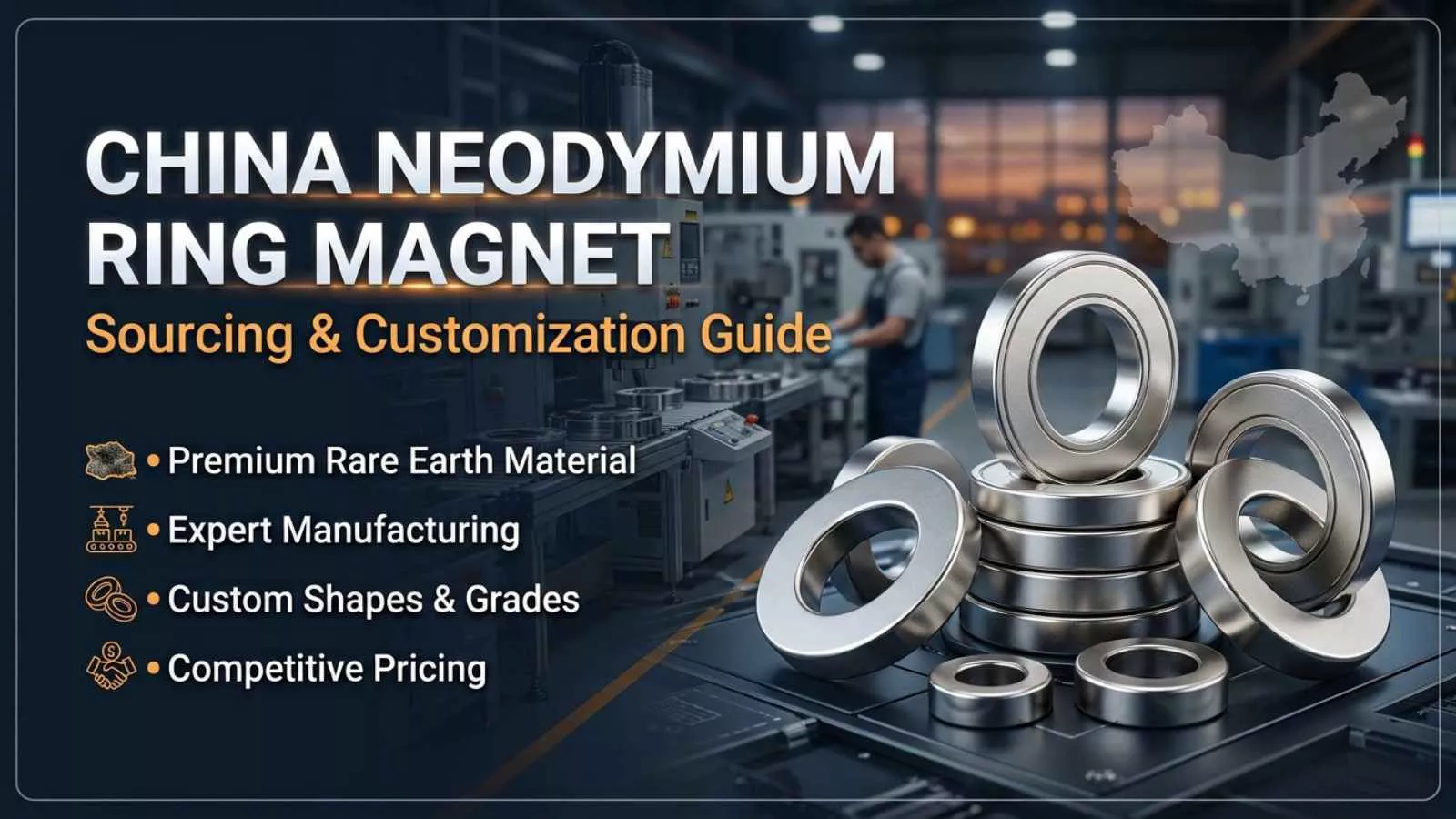
Sourcing a china neodymium ring magnet involves more than selecting a high-strength magnet at a competitive price. For OEM and industrial applications, the final performance depends on several specifications, including dimensions, magnet grade, magnetization direction, coating, tolerance, and operating temperature.
China has an established neodymium magnet manufacturing industry and offers a wide range of standard and customized ring magnet solutions. However, quotations from different suppliers are not always directly comparable. A ring magnet with the same nominal size and grade can have different magnetization, tolerances, coatings, and magnetic performance.
This guide explains the key specifications, manufacturing considerations, supplier evaluation criteria, and RFQ requirements that global buyers should understand when sourcing custom neodymium ring magnets from China.
Table of Contents
A neodymium ring magnet is a permanent magnet made primarily from neodymium-iron-boron (NdFeB) material and manufactured with a central hole. The ring-shaped design makes it suitable for applications where a magnetic component must surround a shaft, wire, sensor, or other mechanical structure.
Basic Dimension Formula:
Outer Diameter (OD) × Inner Diameter (ID) × Thickness (T)
For example, a specification of OD 50 mm × ID 30 mm × T 10 mm defines the basic physical geometry of the ring.
However, dimensions alone are not enough for procurement. A complete specification normally includes the magnet grade, magnetization direction, coating, dimensional tolerance, operating temperature, and required magnetic performance.
The central hole can be designed for shafts, fasteners, sensors, mechanical components, or other structures. Depending on the application, the ring can be magnetized axially, diametrically, radially, or with multiple poles.
The required geometry can also affect manufacturing difficulty. Thin-wall rings, large-diameter rings, tight tolerances, and specialized magnetization patterns may require specific tooling or machining processes.
For custom projects, an engineering drawing or CAD file is therefore preferable to a simple description such as “strong N52 ring magnet.”
NdFeB magnets offer high magnetic energy density in a relatively compact form, making them suitable where space and magnetic output are both important.
Available grades range from standard grades to higher-performance and temperature-resistant grades. The appropriate grade depends on the application rather than simply choosing the highest available grade.
China is an important manufacturing base for NdFeB permanent magnets, supported by established material supply chains, magnet processing capabilities, machining facilities, and finishing services.
For international buyers, this manufacturing ecosystem can be particularly useful when a project requires custom dimensions, specific magnetization, special coatings, or repeated production at different volumes.
Chinese manufacturers can supply both standard ring magnets and customized geometries. Depending on the supplier, production may cover material preparation, sintering, machining, surface treatment, magnetization, and inspection. This makes China a practical sourcing option for projects that require more than an off-the-shelf magnet.
Customization can include OD, ID, thickness, tolerance, grade, coating, and magnetization direction. Some manufacturers can also develop specialized radial or multipole configurations for motors, sensors, encoders, and other precision applications.
A suitable China neodymium ring magnet supplier should be capable of supporting the project beyond the initial sample. Prototype production allows dimensions and magnetic specifications to be verified before moving into larger-volume manufacturing.
Ring magnets commonly require machining after sintering to achieve the required OD, ID, and thickness. Additional finishing may include coating and magnetization. Working with a supplier that understands the complete manufacturing process can simplify communication and reduce risks.
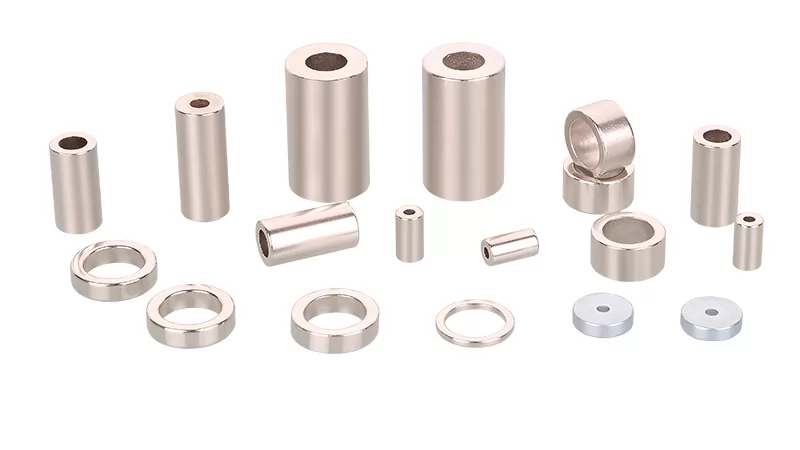
A China neodymium ring magnet should be specified according to the actual application rather than price or magnet grade alone. A complete specification allows manufacturers to quote accurately and helps buyers compare different suppliers on a technically equivalent basis.
The three basic dimensions are outer diameter (OD), inner diameter (ID), and thickness (T). OD determines the overall size, while ID defines the central opening. Thickness affects available magnetic material and mechanical structure.
Common NdFeB grades include N35, N38, N40, N42, N45, N48, N50, and N52. Higher grades generally provide greater magnetic performance, but the highest grade is not automatically the best choice.
Temperature can affect the magnetic performance of NdFeB magnets. Before selecting a grade, the buyer should define the expected operating temperature and any short-term temperature peaks.
Tolerance should be specified for every critical dimension (OD, ID, Thickness, Concentricity, Surface finish). Additionally, applications may require defining target surface magnetic fields, pull force, or flux.
| Specification | What to Define |
|---|---|
| Dimensions | OD × ID × T |
| Grade | N35–N52 or application-specific grade |
| Temperature | Maximum operating temperature |
| Tolerance | Critical dimensional tolerances |
| Magnetization | Required pole direction or pattern |
| Coating | Required surface protection |
| Magnetic performance | Field, flux, pull force, or application target |
Magnetization determines where the magnetic poles are located and therefore how the ring magnet interacts with surrounding components. It should be treated as a core specification rather than an optional detail.
An axially magnetized ring has its north and south poles on opposite flat faces. This is one of the most common configurations and is suitable for applications where the magnetic field needs to act along the central axis.
With diametrical magnetization, the poles are positioned on opposite sides of the ring rather than on its flat faces. This configuration is useful for rotary applications where the magnetic field changes as the ring rotates.
Radial magnetization produces magnetic orientation around the radial direction of the ring, while multipole rings contain multiple alternating magnetic poles around the circumference.
| Magnetization | Typical Applications |
|---|---|
| Axial | Fixtures, holding systems, linear mechanisms |
| Diametrical | Rotary sensors, position detection |
| Radial | Motors, couplings, specialized systems |
| Multipole | Encoders, sensors, motors |
When requesting a quotation, specifying only “N52 ring magnet” is incomplete. Grade, dimensions, magnetization, coating, and tolerance should be defined together to ensure that different China suppliers are quoting the same technical product.
The manufacturing process affects the final dimensions, magnetic performance, coating quality, and consistency of a China neodymium ring magnet. Production generally follows several stages:
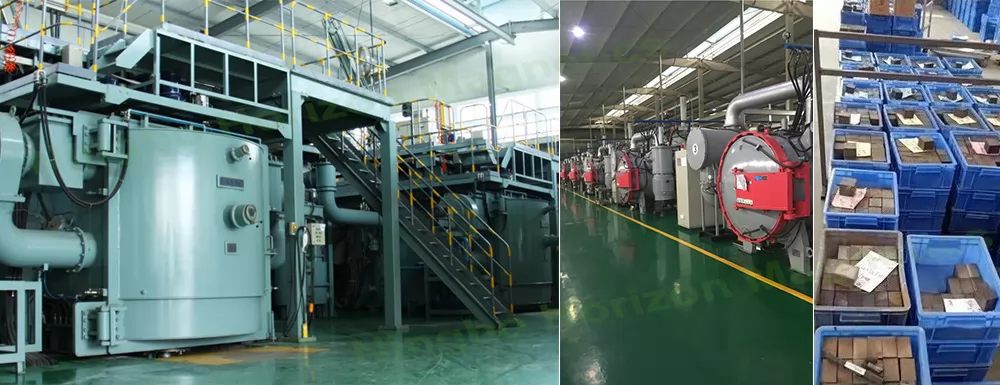
The appropriate coating depends on the operating environment rather than simply the supplier's standard offering:
A supplier should be evaluated on technical capability and production reliability, not quotation price alone.
Confirm whether the supplier maintains in-house machining, coating, and magnetization capabilities. Furthermore, ensure they enforce rigorous quality control across batches, provide inspection reports, and support seamless engineering communication via technical drawings and CAD files.
A complete RFQ helps manufacturers understand exact expectations. Ensure your RFQ includes:
Thanks to their unique central passage, these magnets are integral across various industries:

When sourcing high-performance solutions, Horizon Magnetics (Ningbo Horizon Magnetic Technologies Co., Ltd.) stands out as a specialized manufacturer of custom NdFeB and SmCo magnets.
For ring magnet projects, their capabilities span custom dimensions and complex magnetization patterns for industrial systems. You can explore their full specifications on their neodymium ring magnet page or review industry benchmarks in their guide to the Top 8 Neodymium Ring Magnet Manufacturers in 2026.
There is no single best grade for every application. N35, N42, N52, and other grades provide different levels of magnetic performance. The appropriate grade depends on the required magnetic output, available space, operating temperature, and cost target.
Axial magnetization places the magnetic poles on opposite flat faces of the ring, while radial magnetization follows the radial direction of the ring. The two configurations produce different magnetic fields and are selected according to the specific application requirements.
Yes. Chinese manufacturers can produce customized ring magnets across different dimensions, grades, coatings, tolerances, and magnetization configurations. However, specific capabilities vary by supplier, so custom requirements should be reviewed before production.
The ideal coating depends on humidity, temperature, exposure, mechanical conditions, and required service life. Ni-Cu-Ni is widely used for standard environments, while epoxy or specialized coatings are recommended when additional environmental protection is necessary.
An RFQ should normally include OD, ID, thickness, magnet grade, magnetization direction, coating, tolerance, operating temperature, magnetic requirements, quantity, application, and engineering drawings. Complete details make supplier quotations much easier to evaluate accurately.
Sourcing a china neodymium ring magnet successfully requires more than finding a manufacturer with a competitive price. Dimensions, grade, magnetization, coating, tolerance, temperature, and magnetic requirements all influence the final product.
For global procurement teams, the most effective approach is to define the technical specification first, provide a clear RFQ, and evaluate suppliers based on manufacturing capability, quality control, customization experience, and production reliability.
With these factors established, China serves as a highly practical sourcing base for both standard and customized neodymium ring magnets. Contact Horizon Magnetics today to discuss your technical specifications and request a detailed quote.


Discover the Top 10 China Magnet Manufacturers in 2026! Explore leading suppliers, their specialties, and find the perfect partner for your magnetic material needs.

Discover the top 10 shuttering magnet suppliers in the US for 2025. Explore trusted manufacturers offering high-quality magnetic formwork solutions for the precast concrete industry.
A practical engineering guide to shuttering magnets for precast concrete production. Learn how to select, use, and maintain shuttering magnets to improve efficiency, flexibility, and long-term cost performance.







.png)
.png)