




In modern industrial assembly, countersunk Neodymium magnets are widely used when buyers need strong holding force, flush mounting, and fast screw-based installation in one compact component. They are common in equipment manufacturing, metal fixtures, automation, furniture hardware, construction accessories, and many OEM applications where reliability and appearance both matter.
For B2B buyers and engineering teams, however, sourcing the right countersunk magnet is not only about choosing a diameter and asking for a price. The real decision often depends on whether the countersunk angle matches the screw head correctly, whether the machining precision is stable enough for batch assembly, whether the coating system can survive humidity or corrosion exposure, and whether the supplier is a real manufacturer capable of customization and consistent mass production.
This guide is designed for buyers searching for a practical 2026 reference on customizing and sourcing countersunk Neodymium magnets. It explains the key structural specifications, coating choices, tolerance considerations, sourcing criteria, and quotation details you should confirm before placing a large-volume order.
Table of Contents
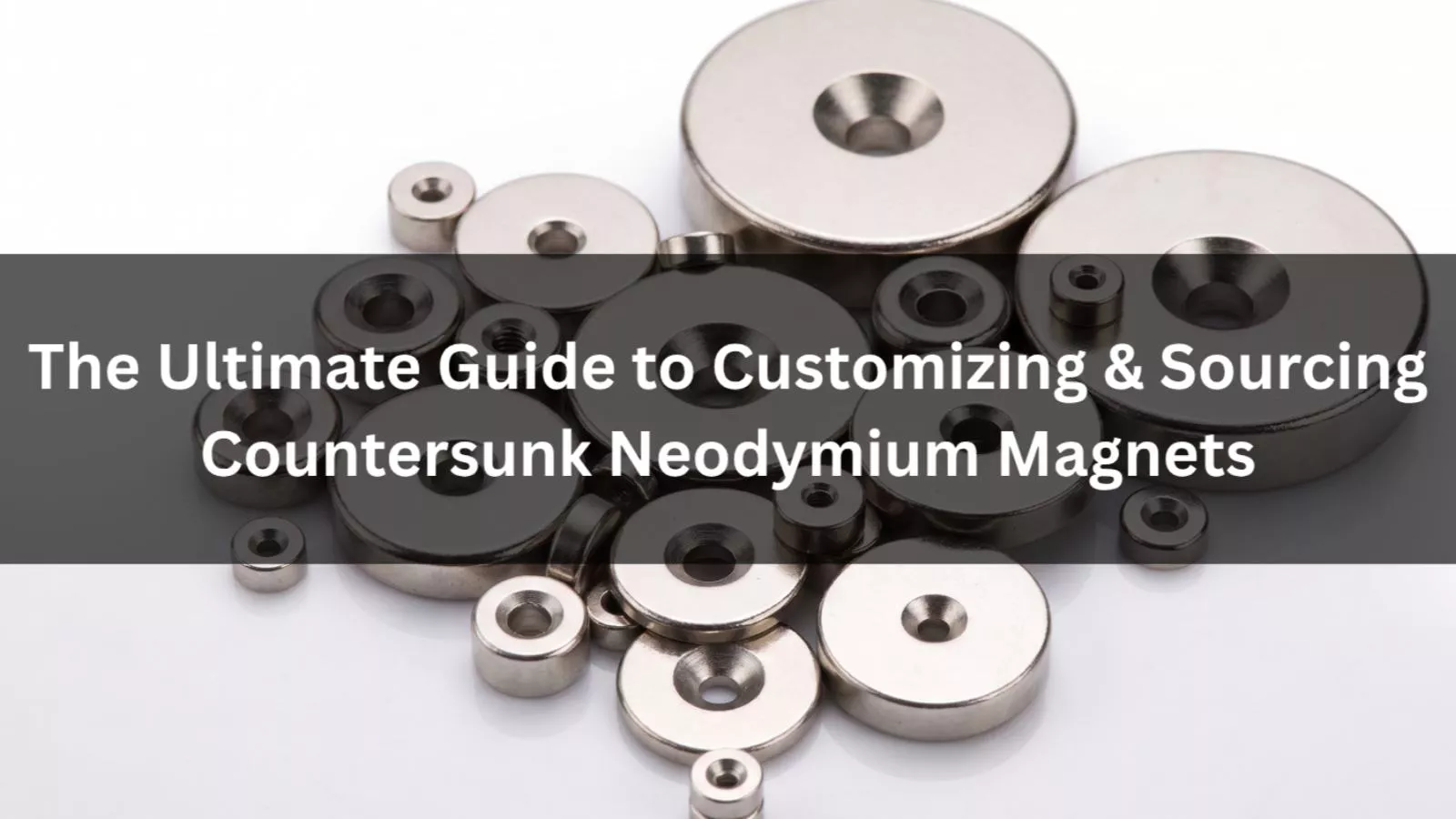
A countersunk Neodymium magnet, also called a countersunk rare earth magnet, countersunk disc magnet, or countersunk ring magnet, is a permanent magnet with a conical mounting hole machined into one face. This hole allows a flat-head screw or bolt to sit partially or fully flush with the magnet surface, creating a cleaner installation and more stable mechanical fastening.
Compared with adhesive bonding or loose mechanical retention, the countersunk structure gives engineers a practical way to combine magnetic holding force and positive screw fixation. That is why it is frequently used in products that need repeated installation, vibration resistance, or accurate positioning.
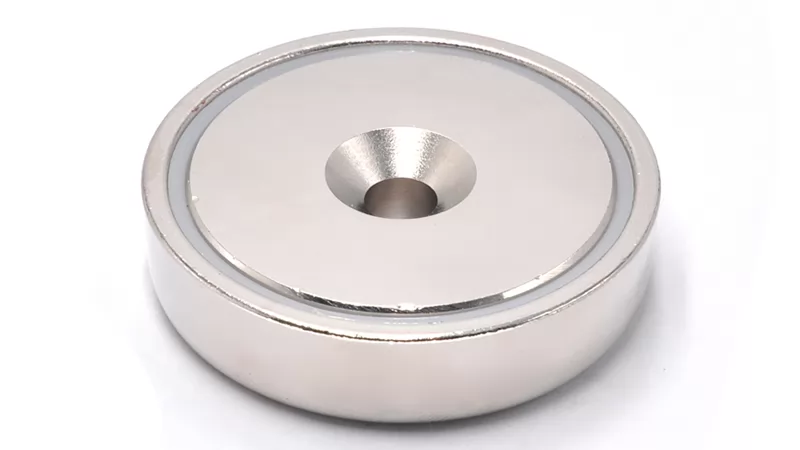
For engineering and procurement teams, countersunk magnets solve several common assembly problems at the same time.
In many cases, a countersunk magnet is chosen not just because it is magnetic, but because it simplifies the full mounting system.
One of the most important technical details in a countersunk magnet project is the countersunk angle. If the angle does not match the screw or bolt head correctly, the assembly may not sit flush, the clamping stress may concentrate at the edge of the hole, and the brittle NdFeB magnet may crack during installation.
The countersunk hole must match the head geometry of the selected fastener. A mismatch may cause:
| Angle | Typical Use | Buyer Notes |
| 90° | Common for many metric flat-head screws and general industrial assemblies | Often the first choice for machinery, fixtures, housings, and general OEM applications |
| 120° | Used in some special fastener systems, rivet-style or wider-head seating applications | Can reduce local stress by distributing contact over a wider cone, but must match the actual fastener standard |
For large-volume procurement, buyers should never assume the angle based only on magnet appearance. Always confirm the screw specification, head angle, and seating depth with the supplier before production starts.
If your project uses a defined screw standard, send the fastener drawing or sample together with the magnet inquiry. A capable manufacturer should verify:
For brittle sintered NdFeB magnets, geometry confirmation is far more important than buyers sometimes expect.
A countersunk magnet RFQ should include more than only outer diameter and thickness. The following specification points are critical for proper sourcing.
Key dimensions usually include outer diameter or length/width, overall thickness, through-hole diameter, top countersink diameter, and countersink angle.
The selected grade affects magnetic strength, temperature stability, and cost. For procurement decisions, buyers typically confirm:
A stronger grade is not always the best solution. In many projects, a manufacturer with application experience can optimize geometry and magnet circuit design to achieve the required performance more cost-effectively.
For most countersunk disc magnets, the common configuration is axial magnetization, meaning north and south poles are on the two flat faces. But for some assemblies, polarity orientation, pair matching, or attraction-side definition must be controlled to ensure correct function.
Quoted pull force values can be misleading if the test method is unclear. Buyers should verify:
A serious manufacturer should explain real application performance, not only publish an attractive laboratory number.
For engineering buyers, machining precision is one of the biggest differences between low-cost samples and reliable mass-production supply. Countersunk NdFeB magnets are brittle and require careful grinding and hole processing. Poor control can cause dimensional deviation, edge chipping, unstable plating coverage, and assembly problems on the line.
Even if the magnet grade is correct, poor dimensional consistency may still create problems such as:
That is why buyers should request not only dimensions, but also tolerance capability, inspection method, and if needed, sample validation before mass production.
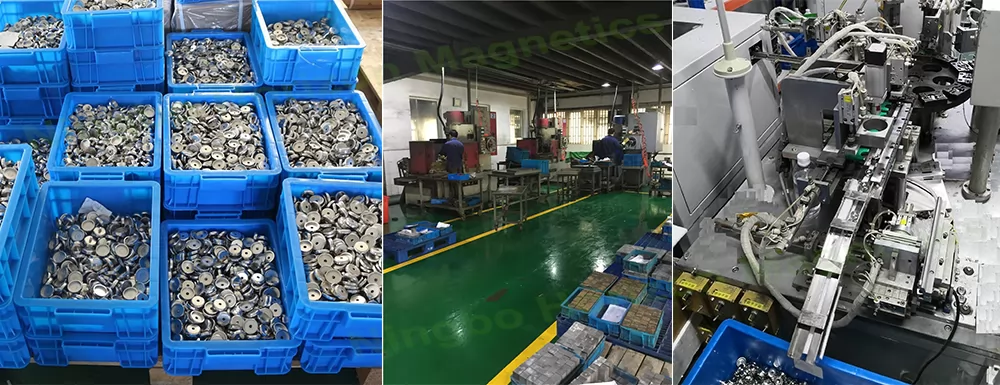
Because sintered NdFeB material is vulnerable to corrosion, surface coating is a major sourcing decision, especially for humid storage, outdoor exposure, condensation risk, or slightly corrosive industrial environments.
| Coating | Main Features | Typical Application Notes |
| NiCuNi | Good appearance, widely used, balanced protection | Suitable for many indoor and general industrial applications |
| Zinc | Economical, basic corrosion resistance | Often selected when cost is a stronger factor and environment is mild |
| Epoxy | Better protection against moisture and chemical exposure | Preferred in humid or more demanding anti-corrosion conditions |
| NiCuNi + Epoxy | Multi-layer protection with improved durability | Useful where both appearance and stronger corrosion resistance are needed |
Coating should be selected based on the real use environment, not only on price. Important factors include:
Buyers should also note that the countersunk edge is a more sensitive area. Poor coating coverage near sharp edges or hole transitions may become the first corrosion point in service. Therefore, anti-corrosion performance depends not only on coating name, but also on coating process quality and machining edge condition.
A capable countersunk magnet manufacturer should be able to offer much more than catalog items. Depending on the project, customization may include:
This customization capability is especially valuable for OEM buyers, because a standard catalog magnet may not fully match the fastening hardware, mounting surface, or force target of the final product.
When buyers need stable long-term supply, the best supplier is usually not just the lowest-price trader, but a real manufacturer that can control quality, machining, coating, and delivery with consistency.
1. Manufacturing background
2. Engineering support
3. Quality assurance
4. Customization flexibility
5. Commercial reliability
For B2B sourcing, this combination of technical depth and delivery stability is usually what determines the true total cost of ownership.
A complete RFQ helps suppliers quote faster and more accurately. If you want useful pricing and technical feedback, try to include the following information:
The more complete the RFQ, the easier it is for the manufacturer to recommend the right solution instead of quoting a generic part that may not perform correctly in your application.
For buyers looking for a practical manufacturing partner rather than only a reseller, Horizon Magnetics offers several advantages relevant to countersunk Neodymium magnet sourcing.
If your project requires custom countersunk angle matching, stable machining quality, reliable coating protection, and competitive large-volume pricing, working directly with an experienced magnet manufacturer can significantly reduce sourcing risk.
You can review the product page for Neodymium Countersunk Magnet or visit the Horizon Magnetics website for more details about their custom magnet manufacturing capabilities.

Sourcing the right countersunk Neodymium magnet in 2026 requires more than comparing prices. Buyers and engineers need to verify countersunk angle compatibility, fastener fit, machining precision, magnetic performance, coating durability, and the supplier’s ability to maintain quality in large-scale production.
Among all technical points, the match between 90° or 120° countersunk geometry and the actual screw system is especially important, because it directly affects flush installation, assembly stress, and long-term reliability. At the same time, coating choice and machining quality largely determine whether the magnet can perform consistently in real operating conditions.
For OEM buyers, industrial distributors, and engineering procurement teams, the safest sourcing strategy is to work with a manufacturer that can provide customization, stable process control, and practical technical communication from sample development to mass production.
Horizon Magnetics supplies customized Neodymium countersunk magnets and other magnetic solutions for industrial applications. If you are planning a bulk purchase or need engineering support for a new project, Horizon can help evaluate your drawing, recommend the right material and coating, and support cost-effective mass production.
Contact Horizon Magnetics today to discuss your custom countersunk Neodymium magnet requirements and request a quotation for your 2026 sourcing plan.


Discover the Top 10 China Magnet Manufacturers in 2026! Explore leading suppliers, their specialties, and find the perfect partner for your magnetic material needs.

Discover the top 10 shuttering magnet suppliers in the US for 2025. Explore trusted manufacturers offering high-quality magnetic formwork solutions for the precast concrete industry.

A practical engineering guide to shuttering magnets for precast concrete production. Learn how to select, use, and maintain shuttering magnets to improve efficiency, flexibility, and long-term cost performance.







.png)
.png)